EDGE GEO — Cellular temperature and humidity logger with location
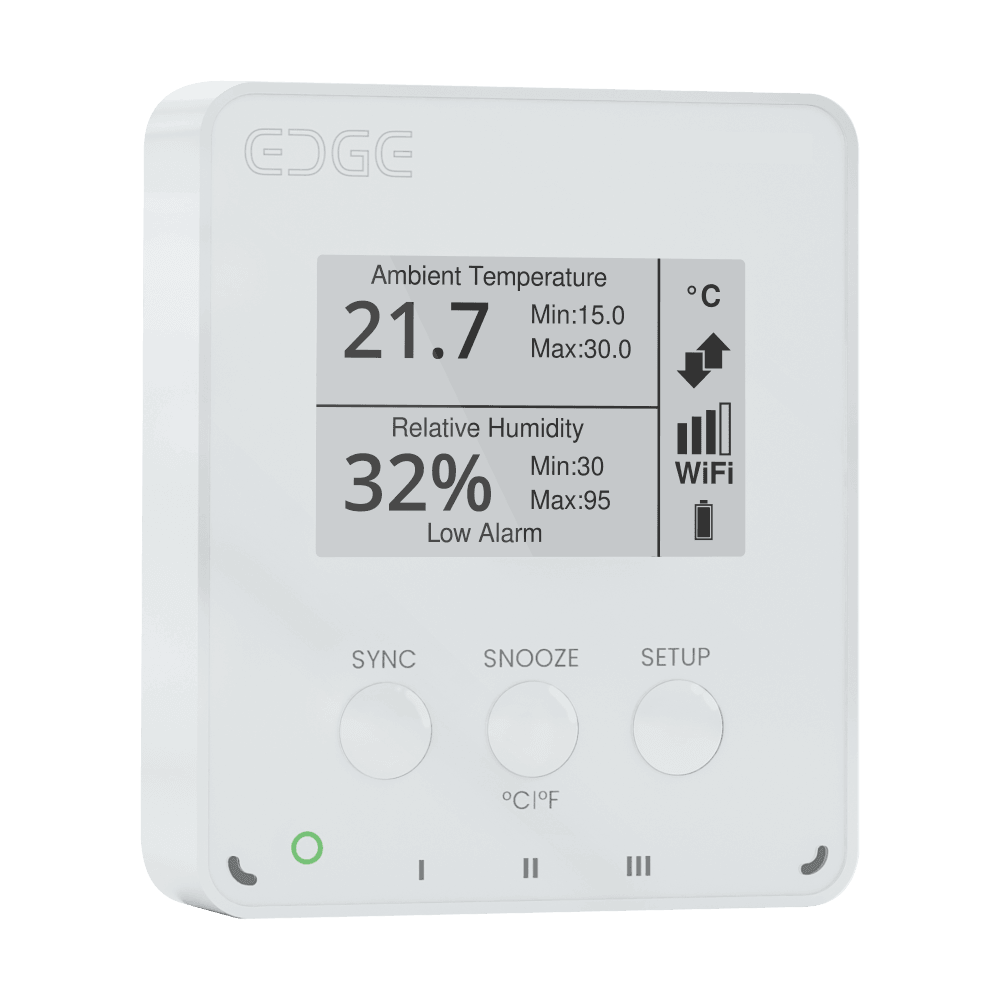
EDGE GEO is technically identical to the EDGE Essential Cellular logger — the same no-gateway design with built-in global cellular (eSIM) plus WiFi, the same patented power management for up to 3 years on 4 AA batteries, and the same on-device alarms and NIST-traceable accuracy. The one addition: it reports its geographic location with every cloud upload. Instead of GNSS/GPS satellites, EDGE GEO derives its position from cellular-tower and WiFi-network triangulation — so it works indoors, inside vehicles and shipping containers, and anywhere without a clear view of the sky, with no external power and no separate GPS module. Ideal for mobile cold-chain, asset tracking and in-transit compliance where you need both the temperature history and where it happened.
Frequently asked questions
What is the difference between the EDGE and BLOCK families?
EDGE is the sealed, display-equipped line: ambient temperature and humidity, external probes down to -55 C, CO2, plus pharmacy and in-transit variants. Every EDGE unit has an on-screen display, an audible buzzer and a visible on-device alarm, and most models come in matched WiFi and cellular pairs. BLOCK is the industrial and retrofit line: one compact WiFi housing with sensor ports for fluid pressure, current clamps, pulse counting, 4-20 mA loops, differential pressure and light. The principle is swap the probe, not the device, because calibration lives with the plug-in sensor, so recertifying means a new probe rather than an RMA.
What are the EDGE variants and what does each one add?
Essential logs ambient temperature and humidity at ±0.2 C. Essential PLUS adds one external temperature and humidity probe so the measurement point sits away from the logger. Thermo ships with two detachable digital probes covering -55 C to +125 C for freezers and cold rooms. Pharma ships with two NIST-traceable probes rated -20 C to +50 C. Air adds CO2 alongside temperature and humidity. EDGE Lite is a compact min/max WiFi thermometer reading ambient temperature and one external probe at ±0.5 C. GEO adds LTE with GPS tracking for shipments in transit. Most variants come in matched WiFi and cellular pairs.
What do I need before I install a logger?
A free LF Cloud account and the device label. Go to app.LoggerFlex.com, create and verify the account, then add the device using its Serial Number and DUID. On EDGE you can scan the QR on the display to fill both in; on BLOCK they are printed on the label at the back; on CORE, press the gear button and they appear on screen for three minutes. The registration wizard sets the recording interval, syncing interval and alarm thresholds and pushes them down on first connection. Register before setup — on BLOCK, before you even power the unit.
How do I connect a logger to Wi-Fi?
Register the device first, then press the SETUP button — the right button on EDGE, the top button on BLOCK. The logger raises a temporary Wi-Fi network called Datalogger. Join it from a phone, tablet or laptop. A setup page opens on its own; if it does not, browse to 8.8.8.8. Pick your 2.4 GHz network, type the password and connect. The device then pulls its logging settings and thresholds from LF Cloud. Press SYNC — left button on EDGE, bottom on BLOCK — to force an upload and confirm it is online.
What are the network requirements for a Wi-Fi logger?
2.4 GHz only — 5 GHz is not supported. That is deliberate: 2.4 GHz carries further through concrete and steel, which is what industrial sites are made of. The network must use a WPA or WPA2 pre-shared key and hand out addresses by DHCP; static IP is not supported, and the password is case-sensitive. The device cannot join a network with a captive portal or a secondary login page, which rules out most guest, hotel and campus SSIDs. Dual-band routers and mobile hotspots are fine as long as a 2.4 GHz SSID is reachable.
Do I need a gateway, hub or bridge?
No. Every EDGE and BLOCK unit reaches LF Cloud on its own — BLOCK and Wi-Fi EDGE models over your existing Wi-Fi, cellular EDGE models over their built-in modem — so there is no proprietary gateway to buy, mount or maintain and no IT project to schedule. The cellular water meter works the same way, with its own 4G modem and managed SIM. EDGE also broadcasts Bluetooth for local viewing, and that is the single exception: a LoggerFlex gateway is needed only to capture BLE data. Logging, alarms and cloud reporting all work without one.
How quickly does data reach the dashboard?
Two independent clocks run. The recording interval decides how often the device measures and stores a reading locally; the syncing interval decides how often it uploads. A device can look quiet simply because its next scheduled upload has not happened yet. Alarms bypass the sync clock entirely — a threshold breach forces an immediate sync, drops recording to once a minute and sounds the buzzer for five seconds. Shortening the sync interval does not make alarms faster, it only costs battery. EDGE units left on USB-C power sync every 15 minutes.
What happens if the internet drops — do I lose readings?
No. The logger keeps measuring and stores every reading with its timestamp in internal memory, then uploads the whole backlog automatically the next time it connects, so the history closes with no gaps. If a scheduled upload is missed, LF Cloud sends a Missing Upload email so you know a device has gone quiet. One caution for sites with poor coverage: an alarm raised while the device is offline makes it retry repeatedly and drains the batteries fast, so use Battery Saving sync mode and leave alarms off where you are logging without a connection.
How long do the batteries last?
Up to 3 years on 4 AA batteries, using a power-management architecture protected by US Patent US11455877B2. That is the rated figure published for the EDGE Wi-Fi loggers, and BLOCK is specified at up to 36 months on cells. EDGE units with an E-INK display typically run two to three years in the field, and EDGE Lite is rated up to two years. Real-world life depends on your recording interval, sync interval, alarm activity, signal quality and ambient temperature, so we size it against your actual deployment.
What actually shortens battery life on site?
Four things. Recording and sync intervals: logging every minute and uploading every hour drains far faster than the defaults. Alarm activity, because every transmission powers the radio. Weak Wi-Fi signal, which forces the device to retransmit packets. And temperature, since extreme cold or heat reduces cell efficiency. Leave the default intervals alone unless you have a reason to change them. A shorter sync interval does not make alarms arrive faster, because an out-of-range reading never waits for a scheduled upload.
LoggerFlex Smart Devices Ltd. is a monitoring-device manufacturer headquartered in Vancouver, Canada, that sells through distributors and resellers. The range covers WiFi and cellular data loggers and alarms (the EDGE and BLOCK families) that report to LF Cloud without a gateway, and whose patented power management (US Patent US11455877B2) runs EDGE and BLOCK loggers for up to 3 years on 4 AA batteries; single-use NFC temperature loggers for shipments; cellular and WiFi water meters; and remote water quality monitoring.